Young children learn Mandarin reading and writing differently than adults — and that difference is their greatest advantage. While grown-ups see thousands of unfamiliar symbols and feel overwhelmed, a three-year-old’s brain treats Chinese characters the way it treats everything else: as shapes to explore, patterns to recognize, and puzzles to solve with their hands.
The science is clear: children who learn character-based writing systems before age six develop visual-spatial processing skills, fine motor precision, and pattern recognition abilities that transfer to every subject they’ll ever study. Here’s how it actually works — and why Phoenix families at Beibei Amigos are giving their children this remarkable head start.
Why Is Learning Mandarin Characters Different from Learning the Alphabet?
Key Takeaways:
- English uses 26 letters to build words; Mandarin uses individual characters that each carry meaning
- Learning characters activates BOTH hemispheres of the brain (alphabetic reading primarily uses the left)
- Children don’t need to learn thousands of characters — just 300-500 covers 80% of everyday reading
When your child learns the English alphabet, they’re learning a phonetic code — 26 symbols that represent sounds, combined into words. It’s powerful, but it’s one-dimensional: letters → sounds → words.
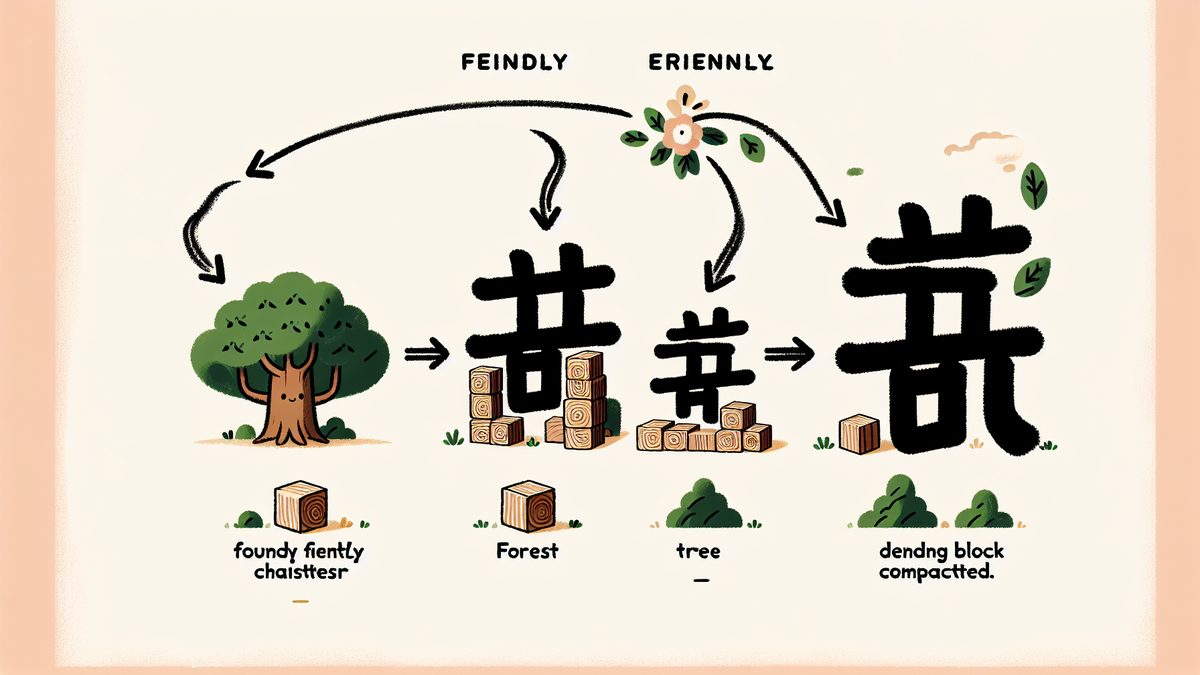
Mandarin characters work fundamentally differently. Each character is a logograph — a visual unit that carries meaning directly. The character 木 (mù) doesn’t spell out “tree” sound by sound. It is tree. Two trees together (林, lín) become “forest.” Three trees (森, sēn) become “dense forest.” Children see the logic immediately — it’s visual storytelling built into the writing system itself.
Research from the Chinese University of Hong Kong (2019) found that children learning character-based systems activate regions in both brain hemispheres during reading, while alphabetic readers primarily engage the left hemisphere. This bilateral activation strengthens neural connections that benefit mathematical reasoning, spatial awareness, and creative problem-solving — skills that have nothing to do with language.
How Do Preschoolers Actually Learn to Write Chinese Characters?
If you’re imagining rows of children copying characters over and over on lined paper, that’s the old way. Montessori-based Mandarin literacy looks completely different — and it’s far more effective for young learners.
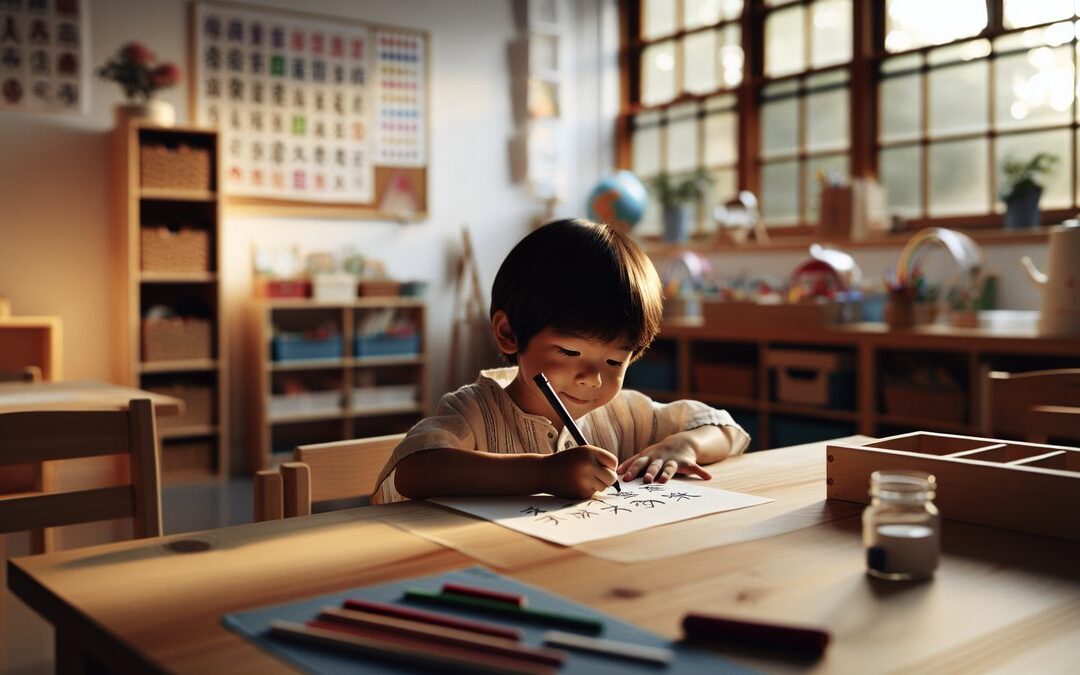
Stage 1: Sensory Exploration (ages 2-3). Children trace characters in sand trays, form strokes with finger paint, and feel textured character cards. This isn’t art time — it’s building the fine motor neural pathways that precise character writing demands. Maria Montessori discovered over a century ago that the hand teaches the brain. Neuroscience has since confirmed it: motor memory cements visual memory.
Stage 2: Stroke Order and Structure (ages 3-4). Children learn that every character follows a specific stroke order — top to bottom, left to right, outside to inside. This isn’t arbitrary rules. Stroke order creates motor consistency, meaning the hand remembers the character even when the conscious mind forgets. Children at this stage can typically recognize and write 50-80 high-frequency characters.
Stage 3: Radical Recognition (ages 4-5). This is where the magic happens. Children discover that characters are built from reusable components called radicals (部首, bùshǒu). The water radical (氵) appears in river (河), lake (湖), and ocean (海). Once a child recognizes 40-50 radicals, they can decode hundreds of unfamiliar characters — just like English readers use phonics to sound out new words. It’s the same cognitive leap, applied to a visual system.
What Cognitive Benefits Does Mandarin Literacy Give My Child Beyond Language?
Parents often ask: “Is this really worth the effort? They’re only three.” The research says it’s worth more than you’d expect — and the benefits extend far beyond speaking Mandarin.
Enhanced visual-spatial reasoning. A 2021 study in Developmental Science found that children trained in character writing showed 23% improvement in spatial reasoning tasks compared to peers learning only alphabetic systems. Character writing requires analyzing spatial relationships between components — a skill that directly transfers to mathematics, engineering thinking, and even reading maps and charts.
Superior fine motor control. Writing characters demands precision that alphabetic writing doesn’t. The difference between 大 (big) and 太 (too much) is a single dot. Children develop extraordinary hand-eye coordination and attention to detail — skills that carry into art, music, sports, and science lab work years later.
Stronger pattern recognition. Character-based literacy trains the brain to see systems within systems — radicals within characters, characters within phrases, phrases within context. This is the same cognitive skill that powers coding, mathematical reasoning, and scientific analysis. You’re not just teaching your child to read Chinese. You’re training a pattern-recognition engine.
How Beibei Amigos Brings Mandarin Literacy to Life
At Beibei Amigos, Mandarin reading and writing aren’t worksheets bolted onto a standard curriculum. They’re woven into every Montessori activity. Children trace characters in sand during sensory work. They match character cards to classroom objects during practical life exercises. They hear stories read in Mandarin by native-speaking teachers who grew up reading these characters themselves.
For over 15 years, we’ve refined a Mandarin immersion approach built on one principle: children learn language the same way they learned to walk — naturally, through immersion, at their own pace, with joy as the constant. Our graduates enter Arizona Language Preparatory and other immersion programs with character recognition skills that put them months ahead of their peers.
“千里之行,始于足下” (Qiānlǐ zhī xíng, shǐ yú zú xià) — A journey of a thousand miles begins with a single step.
Frequently Asked Questions
At what age should my child start learning Mandarin characters?
Children can begin sensory exposure to characters as early as age 2 through tracing, sand writing, and tactile cards. Formal stroke work typically begins around age 3-4. The key is that early exposure builds visual familiarity — children who see characters daily from a young age recognize them naturally, just as they learn to recognize letters in English.
How many characters will my child learn at Beibei Amigos?
By PreK-4, most children at Beibei Amigos can recognize 80-150 high-frequency characters and write 30-50 independently. More importantly, they understand the radical system — meaning they have the tools to decode new characters on their own. This foundation accelerates character acquisition dramatically when they enter elementary immersion programs like ALP.
Will learning Mandarin characters confuse my child’s English reading development?
No — research consistently shows the opposite. A 2020 meta-analysis in Bilingualism: Language and Cognition found that bilingual children learning two different writing systems (alphabetic + logographic) showed enhanced phonological awareness in both languages. The skills transfer. Learning characters makes children better English readers, not weaker ones.
I don’t speak Mandarin — how can I support my child’s learning at home?
You don’t need to speak Mandarin to support your child. Display character flashcards at home, watch Mandarin cartoons together (even if you don’t understand them), and most importantly — show enthusiasm. When your child writes their first character, celebrate it. The emotional connection to learning matters more than parental fluency. Our teachers at Beibei handle the instruction; your job is to be the cheerleader.
See Mandarin Literacy in Action
Visit our classrooms and watch children write their first characters. The joy on their faces says everything research papers can’t.